FourSight packs decades of research into practical tools and workshops that help teams think better together.
FourSight's core research...
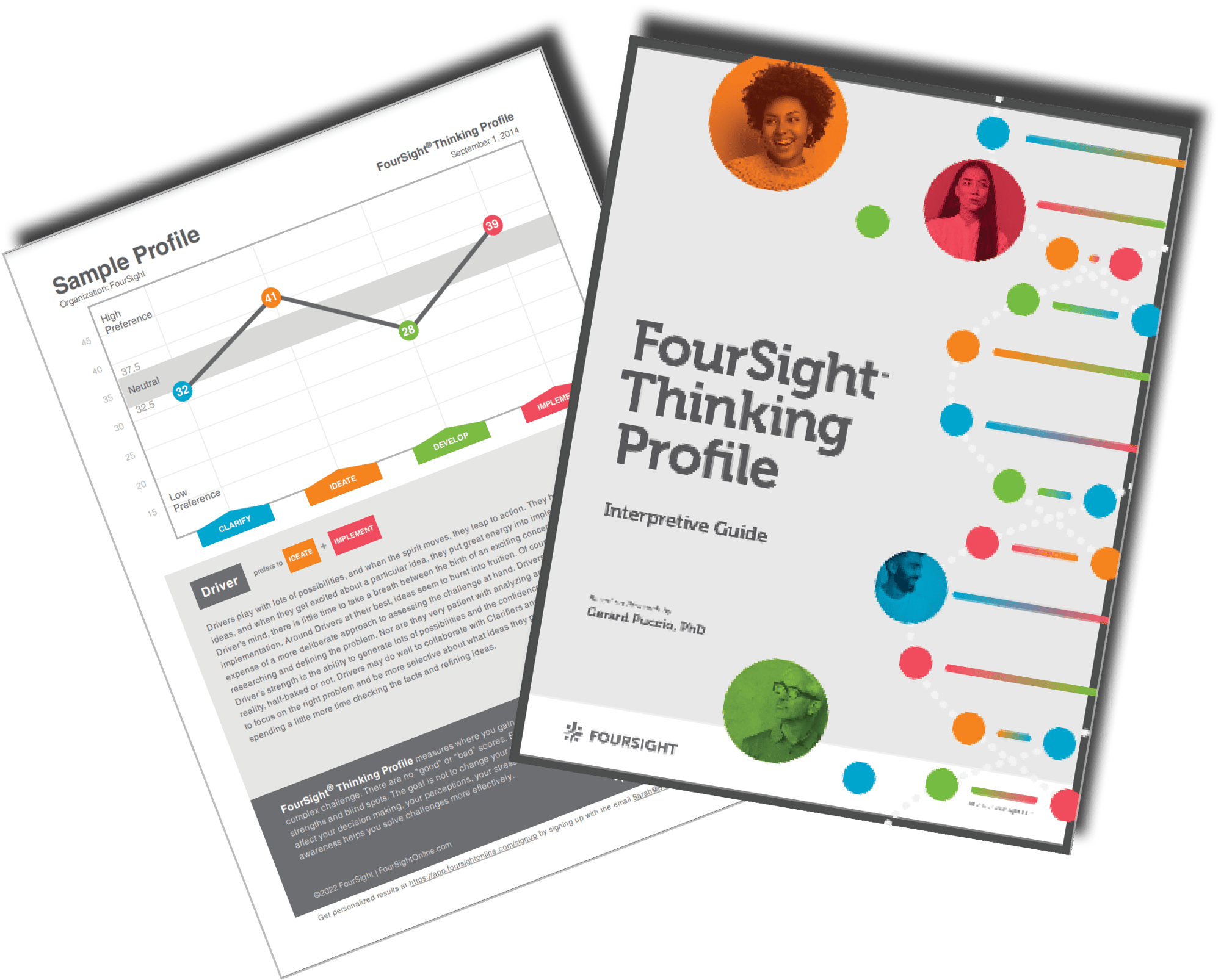
Start with the FourSight Thinking Profile to understand where you contribute energy—and where you may unintentionally create friction.
What FourSight measures is unique:
Workshop 1: The FourSight Mindset Reveal shows how you naturally approach a challenge and gives you tips to think and collaborate more effectively. (2-hours)
Tool: The FourSight Thinking Profile assessment
Next, go from self-awareness to team awareness. Teams don’t fail because people are difficult—they fail because thinking is undisciplined.
Use FourSight to reveal
Workshop 2: FourSight Team Insights & Tools provides team profiles and tools to help teams collaborate smarter and find solutions faster. (3-hour workshop)
Tool: FourSight Team Member Profile + Toolset
Now, put those insights to work. Use the FourSight Challenge Navigator to solve problems that stand between you and your goal.
In a "Challenge Sprint" you can
Workshop 3: The FourSight Challenge Sprint guides teams from problem to solution, while teaching a process teams can use again and again to tackle the challenge ahead. (3 hours)
Tool: FourSight Challenge Navigator (AI enabled)
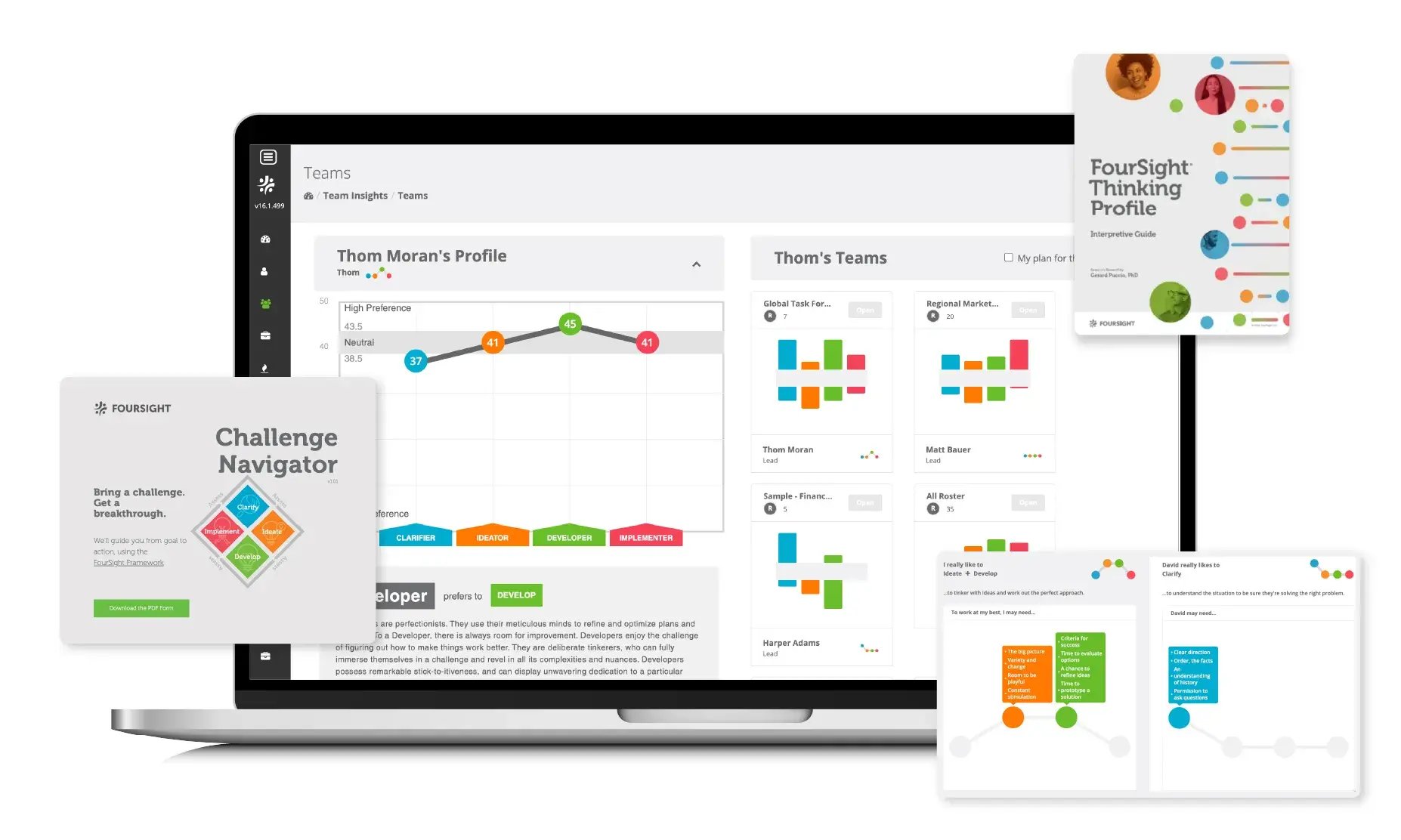
By aggregating profiles, the FourSight Platform helps talent development professional turn individual and team data into organizational intelligence.
Training: Certify in-house trainers to deliver all the above FourSight tools and workshops.
Tool: The FourSight Platform supports enterprise rollouts and ongoing coaching of teams and leaders.
FourSight is built on over 50 years of research into Creative Problem Solving (CPS), developed and validated by Dr. Gerard J. Puccio, Distinguished Professor and Chair of the International Center for Studies in Creativity at SUNY Buffalo State University. His peer-reviewed research — published across journals including Creativity and Innovation Management and The Journal of Creative Behavior, with works cited hundreds of times in academic literature — establishes that when people tackle a complex challenge, they engage in four discrete stages of thought: Clarify, Ideate, Develop, and Implement. The FourSight Thinking Profile is the assessment instrument built to measure individual preferences across these four stages, giving organizations a scientifically grounded tool for improving team performance.
FourSight measures thinking preferences — specifically, which stages of the creative problem-solving process a person naturally gravitates toward or avoids. This is a fundamentally different construct from personality type, behavioral style, or strengths. While many popular assessments tell you who someone is, FourSight tells you how someone thinks when working through a real challenge. For L&D professionals, this distinction is critical: it means FourSight insights map directly onto how work gets done, not just how people describe themselves in a survey.
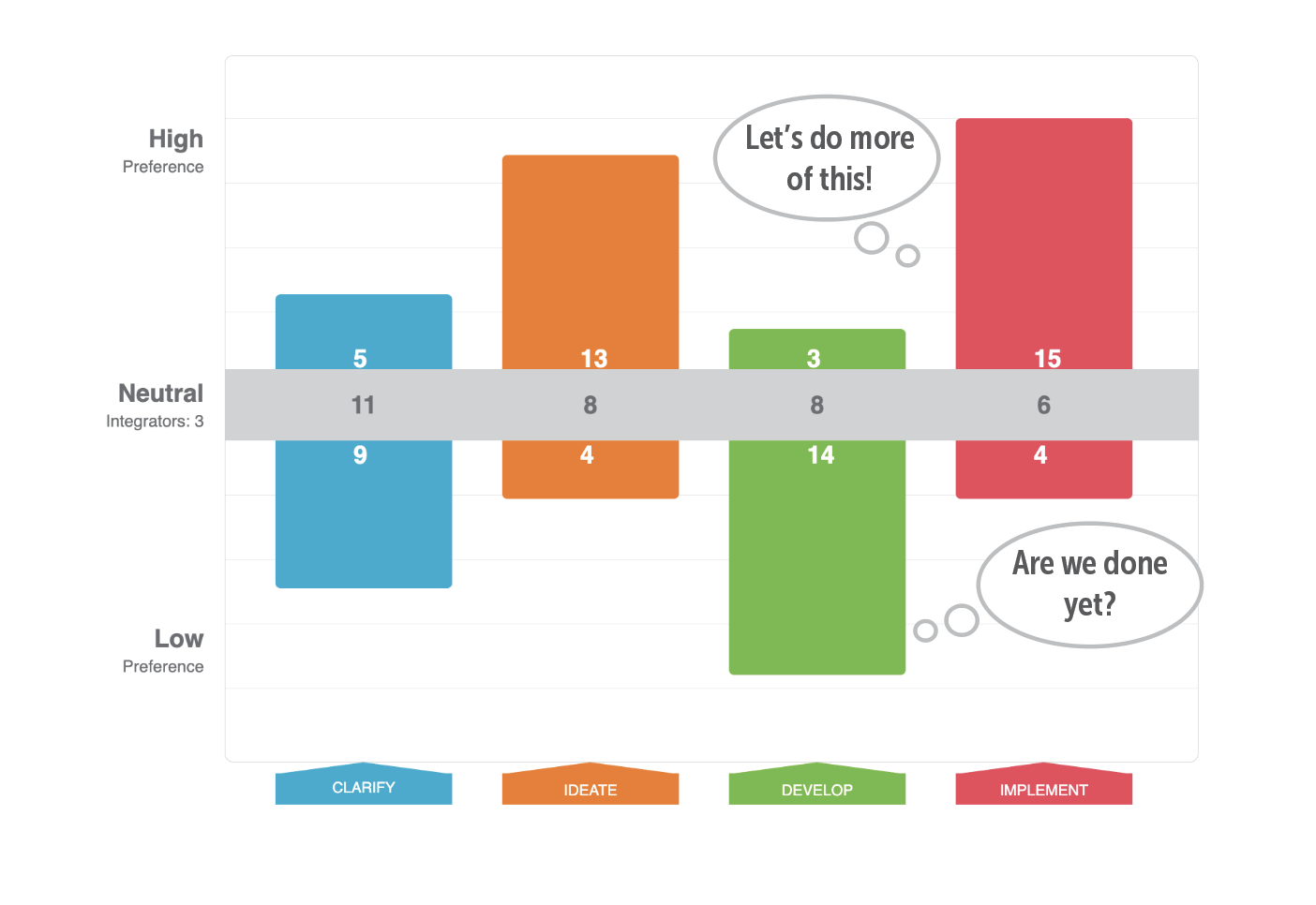
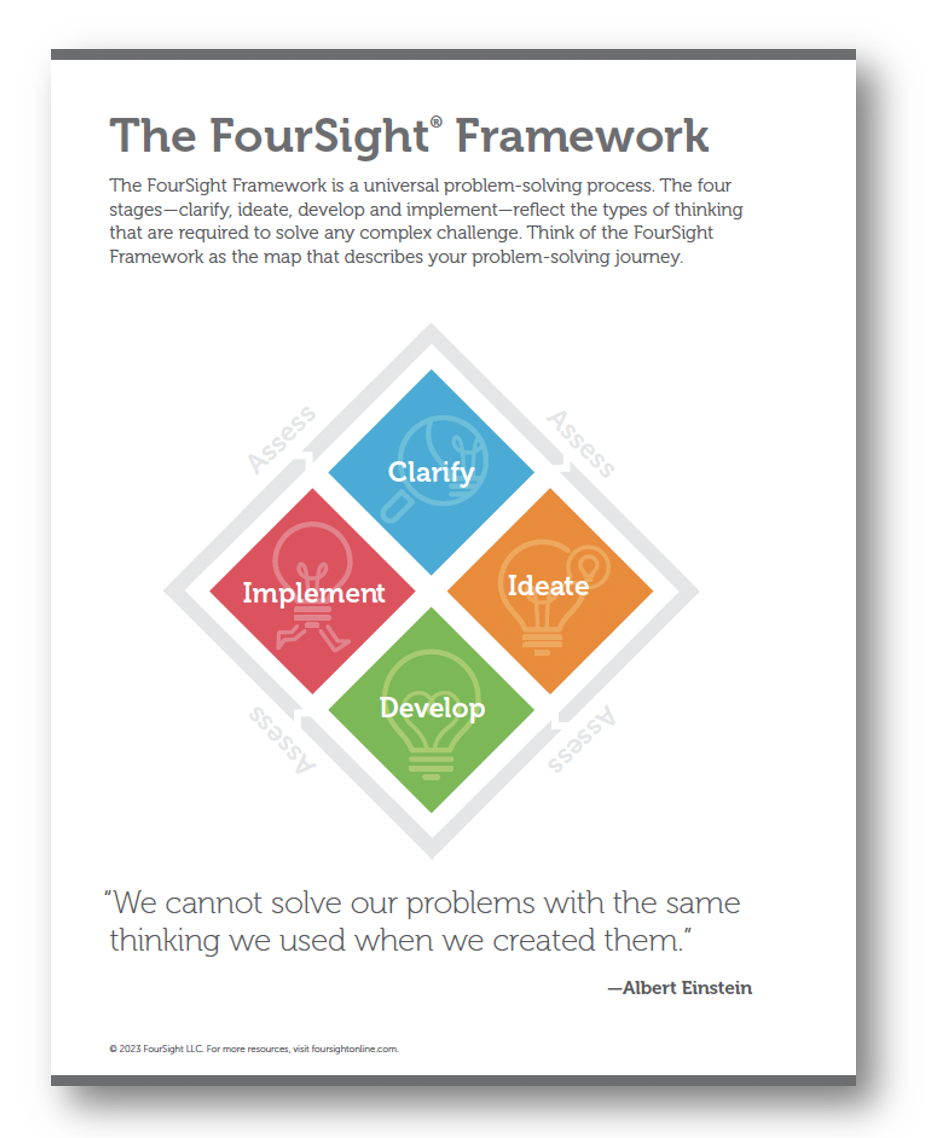
Research by Dr. Puccio and colleagues shows that solving any complex challenge requires four types of thinking: Clarifying (defining the right problem), Ideating (generating possibilities), Developing (refining ideas into workable solutions), and Implementing (driving execution with an action plan). Most individuals have a natural preference for one or two of these stages — meaning they invest energy there and may unconsciously skip or rush the others. When a team lacks awareness of these preferences, whole phases of problem-solving get under-resourced, leading to stalled projects, rework, and friction.
According to FourSight's research, the issue is rarely about effort or talent — it's about undisciplined thinking. When team members don't understand their own thinking preferences or those of their colleagues, they pull in different directions without realising it. Clarifiers want more data; Ideators want to brainstorm; Developers want to refine; Implementers want to act. Without a shared framework and process-awareness, these natural tendencies create conflict and wasted energy rather than complementary collaboration. FourSight provides the shared language and structured process that turns cognitive diversity into a team asset.
For L&D leaders, FourSight offers a scalable system that goes beyond a one-time workshop event. It provides individual assessments, team-level profiling, facilitated workshops, and an enterprise platform that aggregates thinking data across the organisation. This enables L&D professionals to identify systemic thinking gaps, prioritise development interventions based on real data, and build internal facilitator capacity through FourSight certification — shifting team development from episodic training to ongoing organisational capability.
Yes. The FourSight Platform is designed for enterprise-scale rollout. By aggregating individual and team thinking profiles, talent development and HR leaders can surface patterns across business units, identify where the organisation over- or under-invests cognitive energy at scale, and support leaders with actionable data. The certification program also enables organisations to build an internal cohort of trained facilitators, reducing reliance on external consultants and embedding FourSight into standard people-development practice.
The FourSight Thinking Profile is a self-report assessment that takes approximately 10–15 minutes to complete. It produces an individual thinking profile showing a person's preferences across the four CPS stages, which serves as the foundation for the Mindset Reveal workshop. At the team level, individual profiles are aggregated into a Team Member Profile that reveals collective thinking patterns — where the team is likely to gain or lose energy, and where process gaps may exist.
Yes. Dr. Puccio's body of work — spanning publications such as "Differences in creative problem-solving preferences across occupations" (The Journal of Creative Behavior, 2019), "The impact of leaders' creative problem-solving preferences on teams" (International Journal of Innovation and Creativity, 2022), and "Creative leadership: Skills that drive change" (cited over 1,000 times) — establishes both the theoretical model and the practical validity of the FourSight instrument. The University of Arizona's HR department has also adopted FourSight, citing analysis of over six million data points on cognitive diversity in creative problem solving as part of its evidence base.
FourSight is designed to complement, not replace, existing learning frameworks. It layers effectively on top of leadership development programs, team effectiveness initiatives, change management curricula, and innovation training. Because FourSight uses a common language (Clarifier, Ideator, Developer, Implementer), it can be referenced and reinforced across all L&D touchpoints — making it a connective tissue for building a culture of structured, intentional problem-solving rather than a standalone intervention.
Receive three demo seats and a debrief coaching call free when you schedule a demo.
Contact us today to learn more about our offer and how FourSight can help your teams work better together.
If you'd like to learn more about FourSight before scheduling a call, click below to learn about our platform and the science behind FourSight.