How to Run a Strategic Planning Meeting that Finds the Real Challenge

A practical guide for leaders who have to run planning season on top of their day job.

Two separate 100-square grids. In one survey of 7,600 managers, 55% of middle managers could name even one of their company's top five priorities; in another survey of 106 C-suite executives, 85% agreed their organizations were bad at diagnosing problems.
Two surveys, two different groups and two different questions, so the grids are separate and should not be compared with each other. Each square is 1% of respondents; filled squares show the share who gave that answer.

Planning season is here. Soon a group of smart, busy people will sit in a room for a day or two and try to agree on what matters most next year.

Too often, what comes out is a plan nobody remembers. In one survey of 7,600 managers, only 55% of middle managers could name even one of their company's top five priorities. In another survey of 106 C-suite executives, 85% agreed their organizations were bad at diagnosing problems.

Envision the future.
Face the present.
Map the path forward.

The good news is that running a strong strategic planning meeting isn't a secret. Here are the basics.

Prepare before the meeting, then run the room in five parts:

  1. Picture the future, then face the present, with data before opinion.
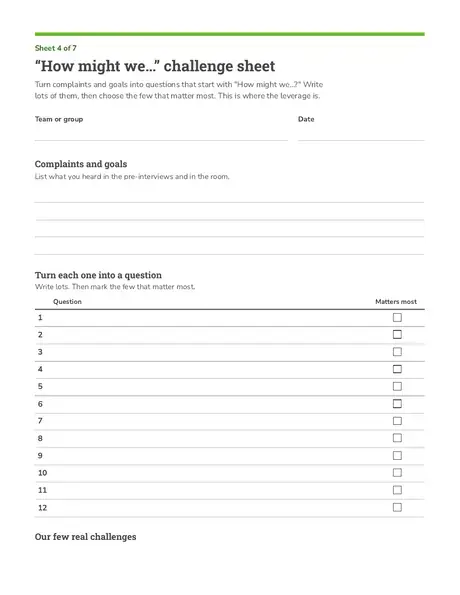
  2. Find the real challenges by turning complaints and goals into "How might we…?" questions.
  3. Generate options by writing silently first; the most senior person speaks last.
  4. Stress-test the plan with a premortem.
  5. Decide and commit to a short list of priorities, each with an owner and a first step, plus what you'll stop doing.

Afterward, send a one-page plan within a week and check progress every quarter.

Before the strategic planning meeting

  1. Set the scope. Are you setting direction, making specific decisions, or allocating money and people? Pick one or two. Researchers at Marakon found that planning works better when it's organized around decisions rather than the calendar.

  2. Talk to people first. Hold a 20-minute conversation with each participant ahead of time. Ask what's working, what worries them, and what they think the group is avoiding. You'll hear things nobody will say in the room.

  3. Send the facts ahead. Share the numbers, customer input, and last year's plan against actual results. Then the meeting can spend its time thinking instead of reading.

  4. Name who decides. Be clear who makes the final call, who advises, and what's out of scope. If the most senior person would otherwise run the day, bring in a facilitator.

In the room: a five-part flow

FourSight partner Russ Schoen puts it this way:

"Great strategic planning does three things. It creates a desired future that leadership is aligned on and excited about. It uncovers the key challenges you need to solve to get there. And it spells out the strategies and objectives for the year that will move you forward.

We believe the best strategic planning uses Creative Problem Solving and lets the whole team bring its best thinking."

Russ Schoen, FourSight partner

Here's how to do that in practice.

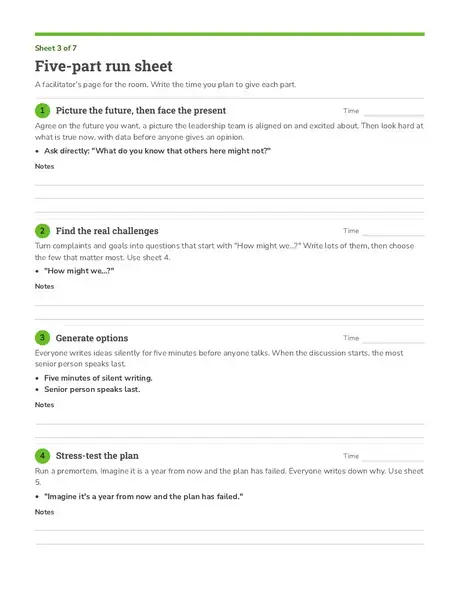
Five numbered steps for the in-the-room part of a strategic planning meeting. 1, Picture the future, then face the present: look hard at what's true now, with data before anyone gives an opinion. 2, Find the real challenges: write lots of them, then choose the few that matter most. 3, Generate options: write ideas silently for five minutes before anyone talks, and the most senior person speaks last. 4, Stress-test the plan: imagine it's a year from now and the plan has failed. 5, Decide and commit: each priority needs an owner and a first step.
The in-the-room flow runs in five steps: agree on the future and look at the data, turn complaints and goals into "How might we...?" questions, write ideas silently before talking, run a premortem, then leave with owners, first steps and a list of what you'll stop doing.
  1. Clarify

    Picture the future, then face the present

    Start by agreeing on the future you want, a picture the leadership team is aligned on and excited about. Then look hard at what's true now, with data before anyone gives an opinion. Groups tend to talk about what everyone already knows and miss what only one person knows. So ask directly: "What do you know that others here might not?"

  2. Clarify

    Find the real challenges

    Turn complaints and goals into questions that start with "How might we…?" Write lots of them, then choose the few that matter most. This is where the leverage is. A plan built on the wrong question will answer it well and still miss.

Write your "How might we" questions

On paper or here: write down a complaint or goal, rewrite it as a question that starts with "How might we…?", and repeat. When you have lots, pick the few that matter most.

    1. Ideate

      Generate options

      Have everyone write ideas silently for five minutes before anyone talks. Studies of brainstorming find that people waiting their turn to speak lose ideas, and writing first helps close that gap. When the discussion starts, the most senior person speaks last.

    2. Develop

      Stress-test the plan

      Run a premortem. Imagine it's a year from now and the plan has failed. Everyone writes down why. You'll surface risks that nobody wanted to be the one to raise.

    3. Implement

      Decide and commit

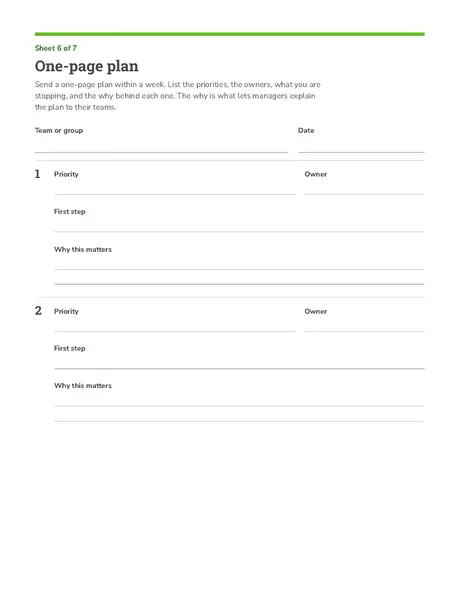
      Leave with a short list of priorities. Each one needs an owner and a first step. Also agree what you'll stop doing, because a plan that only adds work isn't a plan.

    The people part: where things often fall apart

    Those five steps ask for different kinds of thinking, and people aren't equally drawn to all of them.

    Some people jump straight to ideas and would happily skip the data. Others want more information before they'll commit to anything. Some start testing and refining the moment an idea appears. Others just want to get moving.

    All of that is normal. None of it is a flaw. It becomes a problem only when one way of thinking runs the meeting without anyone noticing.

    Expect thinking preferences to show up, especially among leaders

    That risk runs highest at the top. In a FourSight study of 7,280 professionals, senior leaders reported stronger preferences for generating ideas and for taking action than people in non-management and entry-level leadership roles. Preferences for clarifying and developing showed no significant difference across levels. So a leadership team may be naturally drawn to big ideas and fast action, which makes the careful middle steps easy to skip.

    FourSight names four stages of problem solving:

    • Clarify Identify the right challenges.
    • Ideate Generate promising approaches.
    • Develop Make a workable plan.
    • Implement Prepare for action.

    The four cards below show, stage by stage, how senior leaders compared with people in other roles in that study.

    Four cards in order: Clarify, Ideate, Develop, Implement, each in its FourSight stage color and labeled by name. Ideate and Implement carry a diamond with its top half filled and the label "Stronger among senior leaders". Clarify and Develop carry a whole filled diamond and the label "No significant difference across levels". No amounts are shown. Source: FourSight study of 7,280 professionals.
    In a FourSight study of 7,280 professionals, senior leaders reported stronger preferences for generating ideas (Ideate) and taking action (Implement) than people in non-management and entry-level leadership roles. Preferences for clarifying (Clarify) and developing (Develop) showed no significant difference across levels. The study as described here gives no effect sizes, so the figure shows direction only, not how large the differences were.

    When the president wanted "the real vision"

    FourSight founder and professional facilitator Blair Miller once facilitated strategic planning for a Canadian financial services company. The young president was proud of being an industry innovator. His team, though, had told Blair in their pre-interviews that the company needed to shore up its back-office operations, not launch more new ideas.

    Blair opened the session by having everyone look at their thinking profiles. The president had a single high preference: generating ideas.

    Day one went well. The team spent it on operations and felt good about the work, until the president stood up at the end and said:

    "Well, this has been an interesting exercise, but since this vision isn't going to make the company more innovative, I assume we will do the real vision tomorrow."

    The next morning, one executive pushed back, using the language the group had learned the day before:

    "You've got this thinking preference to ideate, and the only way you see us being innovative is to invent new products. We need to innovate by developing sustainable systems under those products."

    The president took a break, thought it over, and agreed. Day two went to making the operations plan real.

    Read the longer version of this story

    Be self-aware, be process aware.

    The team didn't need a different president. They needed a shared way to name what was happening. Four moves help:

    1. Name the stage out loud. Try: "Right now we're clarifying, not solving."
    2. Separate generating from judging. Collect options first, then evaluate them. Don't do both at once.
    3. Guard the stage people rush. Ask the person who loves action to protect the data step, and the person who loves data to push for a decision.
    4. Level-set at the start. Let people see each other's preferences before the hard conversations begin, so a clash reads as a difference instead of a fight.

    After the meeting

    • Send a one-page plan within a week. List the priorities, the owners, what you're stopping, and the why behind each one. The why is what lets managers explain the plan to their teams.
    • Check progress every quarter. People are more likely to reach goals they monitor, especially when progress is written down or shared.
    • Ask one question at each check-in: "What kind of thinking does this priority need next?"

    Checklist for this page

    Strategic planning goes wrong when one way of thinking dominates and nobody notices.

    Where would you focus? What would you rush?

    People are drawn to some stages of problem solving and rush others. For each stage, mark the level that sounds like you. Nothing is saved or sent.

    The FourSight Thinking Profile shows you which stages you're drawn to and which you tend to rush.

    Where do you want to go from here?
    Run the meeting from these sheets

    The planning meeting facilitator kit is seven printable fill-in sheets: a pre-interview guide, a purpose and decision-rights sheet, a five-part run sheet, a “How might we” challenge sheet, a premortem worksheet, a one-page plan, and a quarterly check-in card.

    The kit is yours when you submit, whether or not you tick the box below.

    We use your email to send you the kit. If you tick the box, we also use it for the emails described there. See our privacy policy.
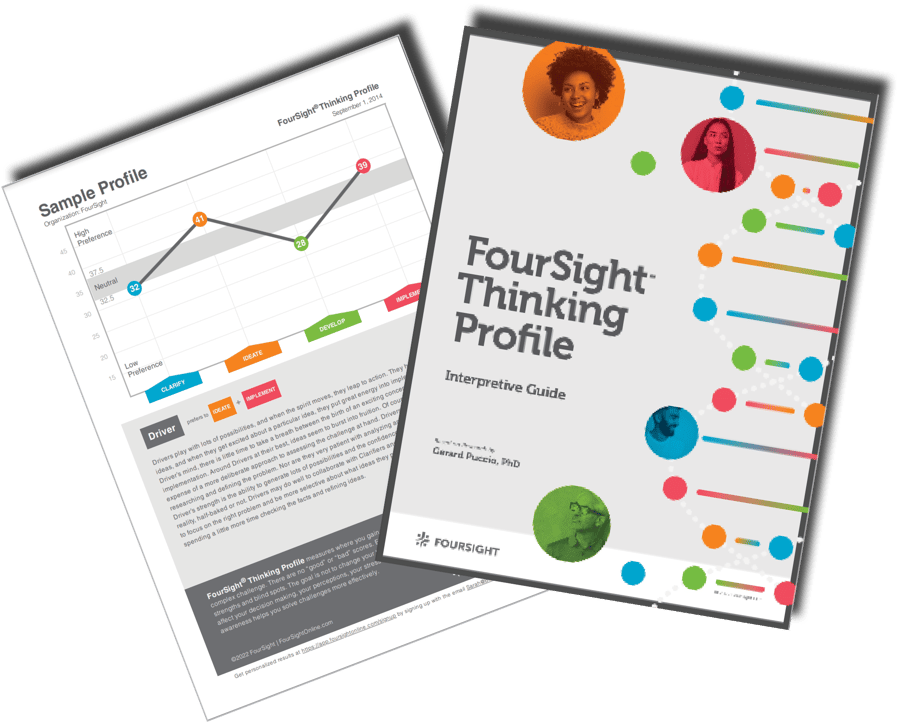
    A sample FourSight Thinking Profile report, with a line across the four stages, beside the printed Interpretive Guide.
    The FourSight Thinking Profile, plus the book

    Give each person the FourSight Thinking Profile, and give the team a copy of Good Team, Bad Team by Sarah Thurber and Blair Miller. People see each other's preferences before the hard conversations begin, so a clash reads as a difference instead of a fight.

    Time
    About 10–15 minutes each
    Price
    $72.50 per person
    You get
    Your profile and an interpretive guide
    Get the profile See a sample report

    The cover of Good Team, Bad Team.

    Want to read first? Good Team, Bad Team by Sarah Thurber and Blair Miller shows how to lead your people to go after big challenges, not each other. Read a free chapter or see the book.
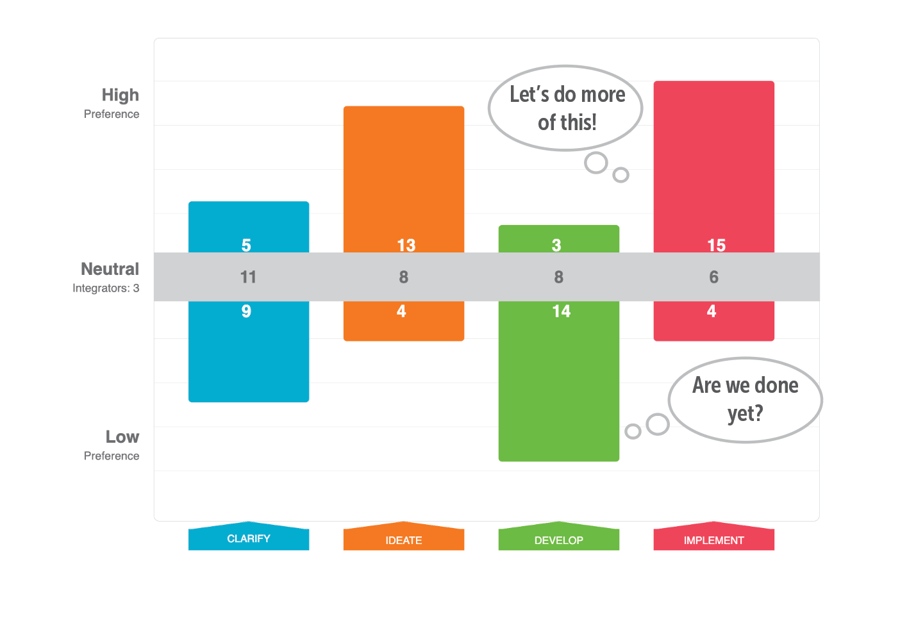
    A FourSight team profile: bars for how many people on a team are high, neutral or low on each stage, with thought bubbles reading Let's do more of this and Are we done yet.
    A team profile puts everyone on one chart, so the room can see where its energy rises and falls.
    A facilitator, so the most senior person doesn't run the day

    Contact us and we'll match you with a certified FourSight facilitator or reseller, for teams of up to 35.

    Find a facilitator See the workshops

    Russ Schoen or Sarah Thurber facilitates your planning session

    Contact us and we'll shape it around your team.

    Talk to a partner

    Questions about strategic planning meetings

    What should you do before a strategic planning meeting?

    Set the scope and pick one or two purposes. Hold a 20-minute conversation with each participant ahead of time. Send the numbers, customer input, and last year's plan against actual results in advance. And be clear who makes the final call, who advises, and what's out of scope.

    What is a premortem?

    Imagine it's a year from now and the plan has failed. Everyone writes down why. You'll surface risks that nobody wanted to be the one to raise.

    How do you keep the most senior person from running the meeting?

    If the most senior person would otherwise run the day, bring in a facilitator. When you generate options, have everyone write ideas silently for five minutes before anyone talks, and when the discussion starts, the most senior person speaks last.

    What should you send after a strategic planning meeting?

    Send a one-page plan within a week. List the priorities, the owners, what you're stopping, and the why behind each one. The why is what lets managers explain the plan to their teams.